
Garage Door Spring Replacement Cost
Springs are the most common garage door failure and the one people most often try to handle themselves. This page covers what a replacement costs, why the price varies, and the specific reason we tell people not to attempt it.
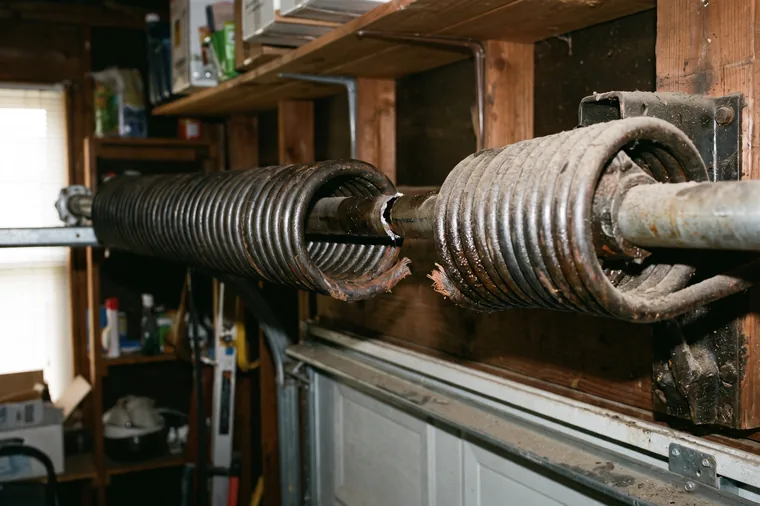
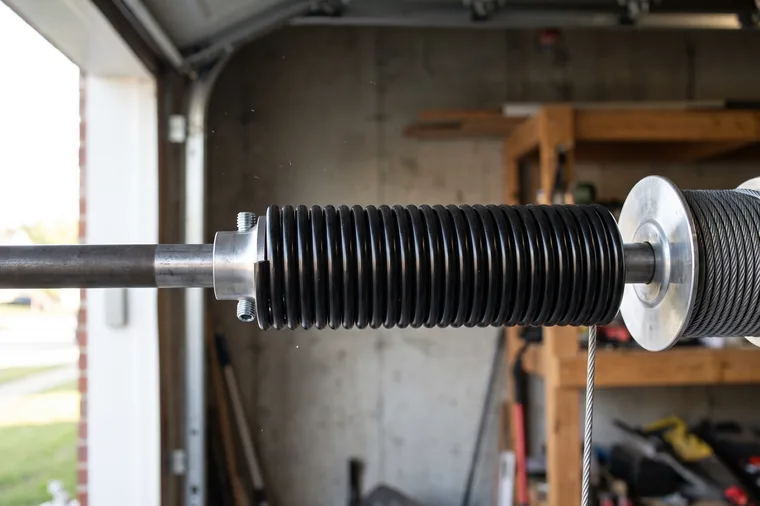
Those two photographs are the same door before and after. The gap in the coil on the left is what a failed torsion spring looks like from the floor — if you can see that, you already have your diagnosis.
What a spring replacement costs
The quote depends on the spring size and cycle rating the door requires, whether it is a single or double door, and whether anything else came apart when the spring let go — a snapping spring frequently takes a cable off its drum on the way. We inspect those parts free and provide the complete written quote before work.
Why springs are rated in cycles, not years
This is the part that explains almost everything about spring pricing and spring failure. A cycle is one open plus one close. A standard residential torsion spring is rated for roughly 10,000 cycles.
- A door opened twice a day reaches 10,000 cycles in about thirteen years.
- A door opened six times a day reaches it in about four and a half years.
- A shared bay under a two- or three-family building, opened ten or twelve times a day, reaches it in under three years.
That is why two identical doors a mile apart in Hudson County fail years apart, and it is why a high-cycle spring rated for 20,000 cycles or more is often the cheaper choice on a multifamily bay even though the part costs more.
How to tell a spring has broken
Three signs, any one of which is enough:
- You heard a bang. A torsion spring failing sounds like something heavy falling over in the garage, or a firework. It often happens with nobody in the room, and the door works normally until the next time you try to open it.
- A visible gap in the coil. Look at the spring on the shaft above the door. A broken one has separated, usually with a gap of an inch or two.
- The door feels like dead weight. Pull the emergency release and lift by hand. A door with sound springs rises easily and holds itself around waist height. One with a broken spring will not lift, or drops the moment you let go.
Why we tell people not to do this one themselves
We are generally happy to talk homeowners through small fixes. This is the exception. A wound torsion spring stores a large amount of energy, and it releases all of it at once if a winding bar slips out of a cone. It is the injury we hear about most in this trade. You also need the correct winding bar diameter, the correct spring for the door's weight and drum size, and the ability to balance the door afterwards — a door left out of balance destroys the opener it is attached to.
The realistic saving over a professional replacement is modest. The realistic downside is a serious hand or facial injury.
One spring or both?
On a two-spring door, both. They went on together and have run the same cycles, so when the first fails the second is typically most of the way through its own rating. Replacing one means a second call-out inside a year. There is one more reason on the older housing stock around here: if the opening has shifted out of square, the two springs were never loading evenly, and pairing a new spring with a tired one makes the imbalance worse rather than better.
How long it takes
Usually under an hour on a standard door, provided the right springs are on the truck. What extends it is the collateral — re-seating cables, re-setting drums, correcting the balance. Tell us what you heard and what the door is doing when you call and we will load the likely parts before we leave.
Common Questions
How much do they charge to replace a garage door spring?
The quote depends on the spring specification, door weight, number of springs and whether cables, drums or brackets were damaged when the spring failed. We inspect the system free and put the itemized price in writing before work starts.
Can I replace a garage door spring myself?
Technically yes, and we would strongly advise against it. A torsion spring stores enough energy to break bones, and it releases all of it if a winding bar slips. You also need the correct bar size, the correct spring for the door's weight and drum, and the knowledge to balance the door afterwards. The saving over a professional replacement is small; the downside is a hospital visit.
What is the lifespan of a garage door spring?
Cycles, not years. A standard residential spring is rated for around 10,000 cycles, where one cycle is one open plus one close. Twice a day gets you roughly thirteen years. Ten or twelve times a day — a shared bay under a multifamily building, which is most of Hudson County — gets you under three. High-cycle springs rated for 20,000 or more exist and are worth specifying on a door that gets heavy use.
How long does a spring replacement take?
Usually under an hour on a standard door once the technician is on site, assuming the right springs are on the truck. What extends it is a door that also needs its cables re-seated, drums re-set or its balance corrected — which is common, because a spring that snapped often took something else with it.
Should I replace one spring or both?
Both, on a two-spring door. They were installed on the same day and have run the same number of cycles, so the second is typically most of the way through its own life when the first goes. Replacing one means paying a second call-out within a year or so. On a single-spring door the question does not arise.
Want It Looked At Today?
We are based in Jersey City and we answer the phone 24 hours a day.