
Garage Door Won't Close
A door that lifts fine but refuses to close is almost never a broken opener. In the large majority of cases the opener is working exactly as designed and refusing to close because it cannot confirm the path is clear. Here is how to find out which case you have, in the order worth checking.
First: read the flashing light
Watch the light on the opener when you press the button. If it blinks instead of staying on, the opener is giving you a diagnostic code. On many LiftMaster and Chamberlain units three flashes means the safety sensor circuit is open or blocked. That single observation resolves most of these calls before anyone touches a tool.
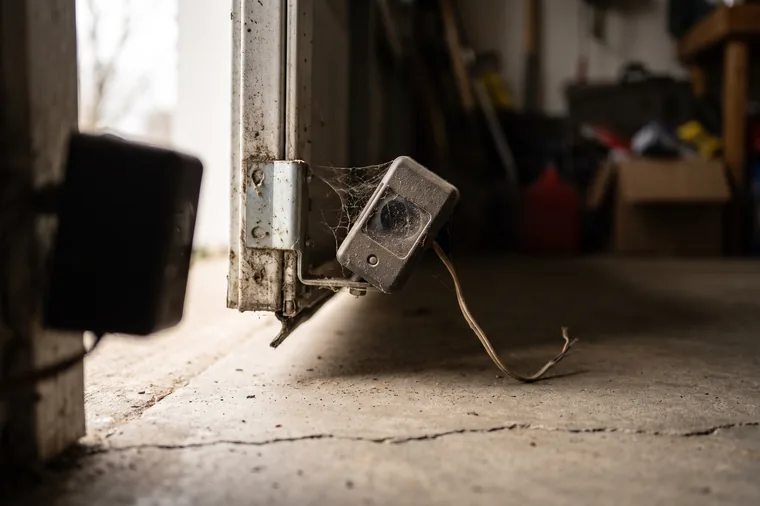
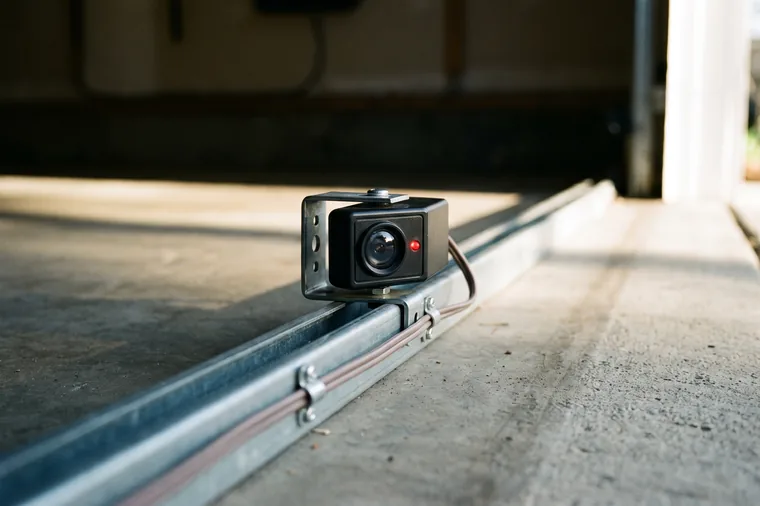
That is the difference you are looking for. The sensor on the left is aimed at the floor instead of across the opening and its indicator is dark; the one on the right is square in a straight bracket with a steady light. Nothing about the opener itself changed between those two photographs.
Second: look at the sensors
The two small units near the floor on either side of the opening are photo-eye sensors. They must face each other, sit at the same height — usually within six inches of the floor — and see an unbroken beam.
- Something in the way. A bin, a bike wheel, a coiled hose, a leaf caught in the bracket. Obvious, and genuinely the cause often enough to check first.
- A dirty lens. Wipe both with a dry cloth. Cobwebs and road dust are enough to break the beam.
- Misalignment. Loosen the wing nut on one bracket and move it slowly until the receiving light stops flickering and holds steady, then tighten it there. Sensors get knocked constantly in a tight garage.
- Sun on the lens. Low winter sun straight into a receiving sensor can wash out the beam at particular times of day. If your door only fails in the late afternoon, that is your answer.
Not every unit shows two green lights, so do not use that as your test. On most openers one sensor shows a steady colour as the sender and the other lights only when it is receiving. Steady on the receiver is what you want.
Third: try the reset
Unplug the opener, wait a minute, plug it back in. That clears a confused logic board and costs you nothing. If it works and then fails again within days, the reset is masking a real fault rather than fixing one.
Fourth: hold the wall button
Most openers will close on a held wall button, overriding the sensor circuit. This is a way to secure your garage tonight, not a repair. Do not disable or bypass the sensors. They are required on residential openers for a reason, and a bypassed sensor is how a closing door reaches a child or a pet.
When it is not the sensors
If the sensors are clean, aligned and lit and the door still will not close, the remaining causes are mechanical or electrical:
- Broken sensor wiring. The low-voltage wire runs at floor level, which is where it gets nicked, pinched or corroded. An aligned pair of lit sensors with a broken wire back to the motor behaves exactly like a blocked beam.
- Travel limits set wrong. The opener is programmed to stop at a floor position. If the door or the frame has shifted, the opener hits its limit early or drives into the floor and reverses.
- Down-force too sensitive. The door meeting the floor reads as an obstruction and the opener reverses.
- The door binds near the bottom. A door that is out of square or running on a damaged track meets real resistance, and the opener does the right thing. This one gets worse every time you run it.
What to do right now
If the door is stuck open, your garage is open. Hold the wall button to close it if the unit allows, and if it will not, pull the emergency release and lower the door by hand — but only if the springs are intact, because with the opener disconnected the springs are the only thing carrying the weight. If you heard a bang before this started, assume a broken spring and do not touch the door. Call us; we answer 24 hours.
Common Questions
Why is my garage door light blinking and the door will not close?
On most openers a blinking light with a refusal to close is the safety sensor circuit reporting a fault, and the flash count is a diagnostic code. Three flashes on many LiftMaster and Chamberlain units means the sensor circuit is open or blocked. The opener is not broken — it is refusing to close because it cannot confirm the path is clear, which is exactly what it is designed to do.
How do I reset a garage door that will not close?
Start by unplugging the opener for a minute and plugging it back in, which clears a confused logic board. If that does not do it, clean both sensor lenses with a dry cloth and check that both are lit. Then loosen one sensor bracket and move it slowly until the receiving light stops flickering and holds steady. If it will never hold steady, the fault is in the wiring or the sensor itself, not the alignment.
Should both garage door sensors be green?
Not necessarily. It depends on the manufacturer — on most units one sensor shows a steady colour as the sender and the other lights only when it is receiving a clear beam. What matters is that the receiving light is steady rather than flickering or dark. Two lit sensors that still will not let the door close usually means the beam is aligned but the wiring between the sensors and the motor has a break.
Can I run my garage door without the sensors?
You can hold the wall button down to force a close on most units, and that is fine as a one-off to secure your garage tonight. Do not disable or bypass the sensors as a fix. They are federally required on residential openers because of what a closing door does to a child or a pet, and a bypassed sensor is the failure that gets someone hurt.
Why does my garage door close and then immediately reopen?
The opener is detecting resistance and reversing, which is correct behaviour with an incorrect trigger. The usual causes are safety sensors slightly out of line, a down-force setting that is too sensitive so the door meeting the floor reads as an obstruction, or a door that binds near the bottom of its travel. The third is the one worth acting on quickly — a binding door is wearing its track every time it runs.
Want It Looked At Today?
We are based in Jersey City and we answer the phone 24 hours a day.